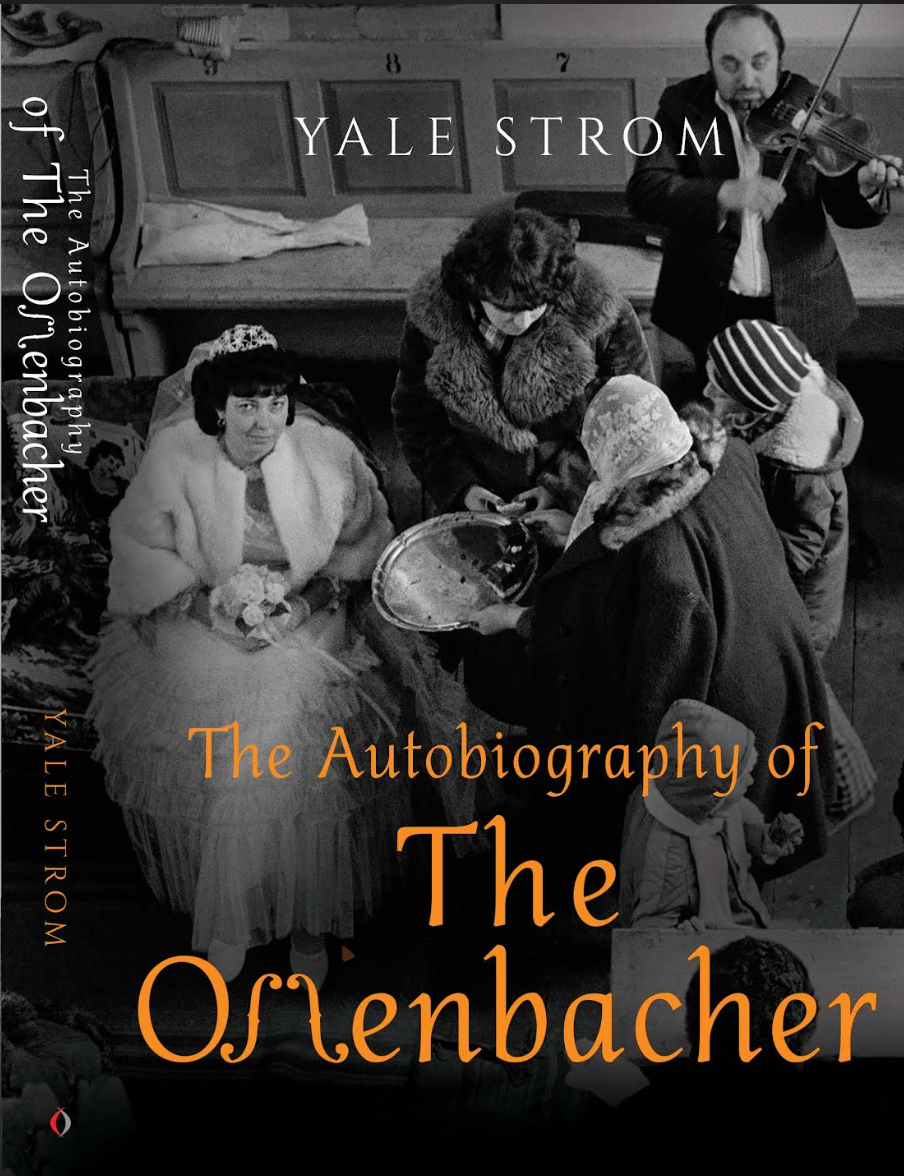
The Soundtrack of Survival: Yale Strom on Music, Memory, and The Autobiography of the Offenbacher

For decades, acclaimed musician, filmmaker, photographer, and author Yale Strom has dedicated his life to preserving the stories, music, and cultural traditions of Eastern European Jewish communities. Through extensive travels across Poland, Ukraine, Romania, Hungary, and the Balkans, he has documented disappearing worlds, interviewed Holocaust survivors, and collected the melodies and memories that continue to shape Jewish identity today. His work—whether on stage, behind the camera, or on the page—has been driven by a passion for ensuring that these voices and histories are not forgotten.
In his latest novel, The Autobiography of the Offenbacher, Strom brings together decades of research and personal experience to create a sweeping narrative that explores memory, survival, music, and the enduring resilience of the human spirit. Blending historical reality with imaginative storytelling, the novel offers readers a vivid journey through the complexities of Eastern European Jewish life while highlighting the universal power of music to connect people across generations and cultures. We spoke with Strom about the inspiration behind the book, the influence of music on his writing, and the lasting message he hopes readers will carry with them long after the final page.
Tell us a bit about your professional background.
I am an internationally recognized musician, filmmaker, photographer, composer, and writer whose work has focused on the history and culture of Eastern European Jewish life. I am best known as one of the leading figures in the revival of klezmer music, and I have spent decades traveling throughout Eastern Europe documenting Jewish communities, interviewing Holocaust survivors, and collecting traditional melodies and stories. As a violinist and bandleader, I founded the ensemble Hot Pstromi, which has performed throughout the United States, Europe, Asia, and Israel, blending traditional klezmer with Romani, jazz, classical, and Balkan influences. My performances are noted for their historical authenticity as well as their emotional depth and improvisational energy.
In addition to my musical career, I have built a distinguished body of work as an author and documentary filmmaker. I have written numerous books on Jewish history, ethnography, and music, including studies of klezmer traditions and Eastern European Jewish culture, along with novels and children’s books. My documentary films explore subjects ranging from Holocaust memory to Romani and Jewish musical traditions, often drawing on years of field research. I have also explored the life of labor and socialist leader Eugene Victor Debs through film. As an educator and lecturer, I have taught and presented at universities, museums, and cultural institutions around the world, helping preserve and illuminate the rich cultural heritage of Ashkenazic Jewry for new generations.
What led you to write The Autobiography of the Offenbacher?
Like millions of others at the beginning of the COVID pandemic, I found myself with some unexpected extra time on my hands. That extra time, combined with the fact that I had never before attempted to write a full-length novel for adults, led me to begin my first novel, The Autobiography of the Offenbacher, inspired by years of ethnographic research, travel, and personal encounters throughout Eastern Europe. During the 1980s and 1990s, I traveled extensively through Poland, Ukraine, Romania, Hungary, and the Balkans, documenting Jewish and Romani life, collecting folk music, photographing communities, and interviewing Holocaust survivors. Along the way, I heard countless stories filled with humor, tragedy, superstition, resilience, and moral complexity stories that often could not be fully conveyed through academic writing or documentary film alone. Fiction gave me the freedom to weave these experiences together into a richer emotional and psychological narrative.
The novel was also inspired by my fascination with memory, identity, and the disappearing world of Eastern European Jewry. Through the fictional character of the Offenbacher, I explored themes I had encountered repeatedly in my research: displacement, survival, wandering, music, mysticism, and the tension between tradition and modernity. Writing fiction allowed me to combine historical reality with imagination, creating characters who could embody the voices and experiences of people I had met over decades of fieldwork. In many ways, the novel became an extension of my lifelong mission to preserve and reinterpret Jewish cultural history through art, storytelling, and music.
As both a musician and writer, does music influence the rhythm or structure of your storytelling process?
For me, music has deeply influenced the rhythm, pacing, and emotional structure of my storytelling. As a klezmer violinist and improviser, I often approach writing the way a musician approaches a performance: themes are introduced, developed, varied, and revisited much like motifs in a musical composition. My prose frequently carries a lyrical cadence, with scenes shifting between moments of exuberance, melancholy, tension, and humor in the same way a klezmer suite can move from joyful freylekhs to a haunting doina. Years of performing traditional Jewish and Romani music also taught me the importance of timing, silence, repetition, and emotional phrasing elements that naturally found their way into my narrative voice.
Music has also shaped the structure of my stories. Rather than writing in a strictly linear fashion, I often layer memories, histories, and character voices the way musical lines intertwine in an ensemble performance. Improvisation, which is central to klezmer music, has encouraged me to allow characters and scenes to evolve organically during the writing process. My three children’s stories and one of my audio dramas include musicians as central figures because music itself becomes a form of memory, identity, and survival. In this sense, my storytelling does not merely describe music; it moves musically, carrying the reader through emotional crescendos, pauses, and recurring themes much like a live performance.
What was the most difficult section to write in the novel?
One of the most difficult sections for me to write in the novel was the death of the Derbarmdiker family in Lviv, Zuza Yisroel, Tsirke, and their son Khatskel, after the German occupation of the city. I considered allowing the family to escape eastward and then south through Romania, eventually crossing the Black Sea to Palestine. Yet, as a historian and ethnographer deeply familiar with Holocaust history in Eastern Europe, I knew that for the overwhelming majority of Jews trapped in the German-occupied Soviet Union, such an escape was rarely possible. To change their fate simply for the sake of hope would have betrayed the historical reality faced by millions.
The emotional challenge came from balancing compassion for the characters with fidelity to history. After spending so much time developing the humanity, humor, dreams, and struggles of the Derbarmdiker family, ironically, in Yiddish, their last name means “merciful,” writing their destruction became personally painful. I understood that readers would become attached to these characters just as I had while creating them. However, I believed it was important to confront the brutal truth of what happened in cities like Lviv, where vibrant Jewish communities that had existed for centuries were nearly annihilated within a short period of time. Writing those scenes required not only historical accuracy, but also emotional restraint and deep respect for the real lives and families whose experiences inspired the novel.
Your career spans filmmaking, photography, music, and writing. How do those different artistic disciplines influence one another in your creative life?
For me, the common thread connecting filmmaking, photography, music, and writing has always been music itself. When I first traveled through the former Eastern Bloc under the lingering Stalinist shadow of the Soviet Union, many people, including Jewish survivors and other informants, were suspicious of why an American would want to spend a year traveling through such places. But once I took out my violin and began playing Jewish music, barriers often disappeared. Music opened hearts and homes. Families who were initially cautious invited me to stay for days or even weeks, sharing meals, memories, photographs, songs, and personal histories that otherwise might never have been revealed.
Those experiences profoundly shaped all of my artistic work. Living among the people I documented gave me the trust and intimacy needed to capture authentic photographs and gather stories with emotional depth and historical nuance. I often point to the Polish Jewish intellectual L. L. Zamenhof, who created Esperanto in the hope that it would become a universal language. Yet I have always believed that the true lingua franca of the world is music. Music transcends borders, politics, religion, and language in ways few other art forms can. Whether I am composing a film score, writing dialogue, photographing a survivor, or performing on stage, music remains the emotional and spiritual core of all my creative pursuits, shaping how I listen to people, how I tell stories, and how I connect human experiences across cultures and generations.
If readers walk away from The Autobiography of the Offenbacher remembering one thing, what would you want it to be?
I would want readers of The Autobiography of the Offenbacher to come away with a deeper understanding of the universal power of music. For me, music transcends language, politics, borders, and even time itself. I believe that every human being is, in essence, a living musical instrument: our beating hearts create rhythm, and our breathing forms a natural cadence from the moment we are born until the moment we die. Music is woven into the very fabric of human existence, connecting people across cultures and generations in ways words alone often cannot.
I also hope readers recognize music’s extraordinary emotional force. Throughout life, music accompanies moments of celebration, longing, love, grief, and remembrance. It can elevate moments of pure exhilaration while also offering comfort during periods of profound sorrow. In the novel, music is not simply entertainment or background atmosphere; it is memory, survival, identity, and spiritual resilience. Through the characters and their journeys, I wanted to show how music can preserve humanity even in the darkest circumstances and remind us of our shared emotional experience as human beings.
For more information, please visit: https://www.yalestrom.com/